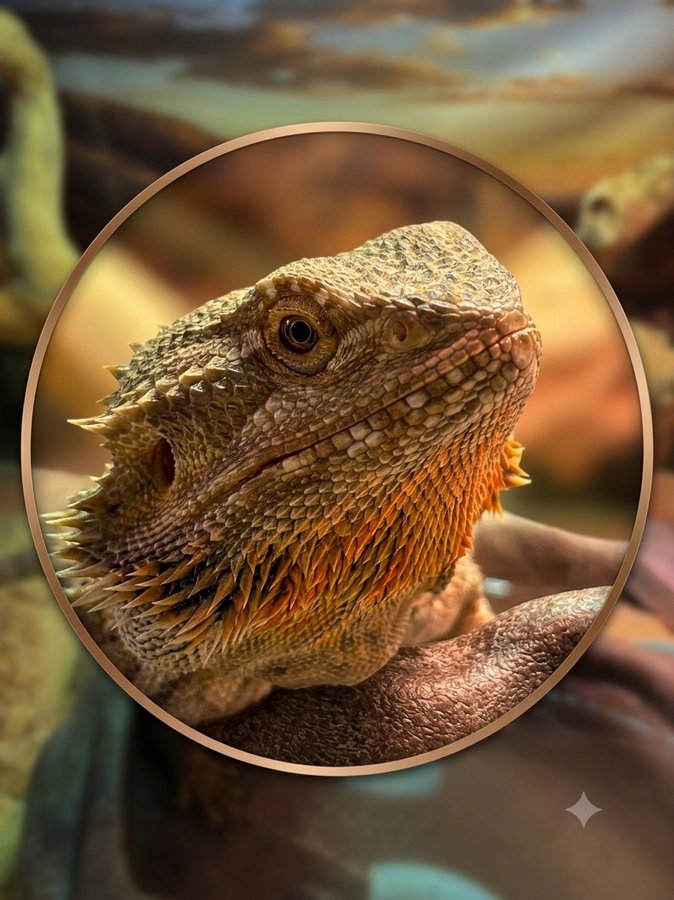
From hatchling to adult
Bearded Dragon Care Guide
Everything we've learned in Falla's first year — the wins, the mistakes, and the things that actually work. Based on our experience and current best practices in the reptile community.
Jump to section
See exactly what Falla uses in her enclosure.
💡 Lighting & UVB
Why UVB is Non-Negotiable
Bearded dragons require UVB lighting to synthesize Vitamin D3, which is essential for calcium absorption. Without proper UVB, dragons develop metabolic bone disease (MBD) — a painful and preventable condition. We use a T5 HO UVB bulb (10.0 or 12%) spanning at least 2/3 of the enclosure length.
Basking Spot Temperature
The basking spot should reach 100–110°F for juveniles and 95–105°F for adults. Use a halogen flood bulb or a dedicated basking bulb. Always verify with a temperature gun — dial thermometers are not accurate enough. The cool side should stay between 80–85°F.
Photoperiod (Light Schedule)
Bearded dragons need 12–14 hours of light per day in summer and 10–12 hours in winter. Consistent schedules support their circadian rhythm and prevent brumation issues. We use smart plugs to automate Falla's light schedule.
🦗 Diet & Feeding
Hatchlings & Juveniles (0–6 months)
Young bearded dragons are primarily insectivores. Feed 3–5 times daily, offering as many appropriately-sized crickets or dubia roaches as they can eat in 10 minutes. Insects should be no wider than the space between the dragon's eyes. Dust every feeding with calcium (no D3) and every other feeding with a multivitamin.
Sub-Adults & Adults (6+ months)
As dragons mature, their diet shifts to roughly 70% plant matter and 30% insects. Offer a fresh salad daily — collard greens, mustard greens, dandelion greens, and squash are excellent staples. Avoid spinach, kale (in excess), and iceberg lettuce. Feed insects 3–4 times per week.
Supplementation
Calcium without D3: every feeding for juveniles, every other day for adults. Calcium with D3: 2x per week. Multivitamin: 1–2x per week. Do not over-supplement — too much Vitamin A or D3 can be toxic.
Hydration
Bearded dragons get most of their hydration from food and baths. Offer a shallow water dish (they often won't drink from it but it helps with humidity). Bathe 2–3 times per week in lukewarm water for 15–20 minutes — this helps with hydration and shedding.
🏠 Enclosure Setup
Enclosure Size
Hatchlings can start in a 40-gallon tank, but adults need a minimum of 120 gallons (4'x2'x2') — larger is always better. Bearded dragons are active and need space to thermoregulate, explore, and exercise. Falla has a 4'x2'x2' PVC enclosure.
Substrate
For juveniles, use reptile carpet, ceramic tile, or paper towels — loose substrates pose an impaction risk. Adults can use properly managed bioactive substrate or a mix of topsoil and play sand (60/40). Avoid calci-sand, walnut shell, and wood chips.
Decor & Enrichment
Provide a sturdy basking platform elevated toward the UVB light, at least one hide on the cool side, and climbing opportunities like driftwood or cork bark. Falla has a large piece of driftwood, slate rock platforms, and a desert-themed background that she ignores completely.
Humidity
Bearded dragons come from arid environments. Aim for 30–40% humidity. High humidity can cause respiratory infections. Ensure good ventilation in the enclosure.
🏥 Health & Vet Care
Finding a Reptile Vet
Not all vets treat reptiles. Find an exotic animal vet or reptile specialist before you need one — not during an emergency. Schedule a wellness exam within the first few weeks of bringing your dragon home and annually after that.
Common Health Issues
Watch for: lethargy beyond normal brumation, loss of appetite lasting more than 2 weeks, runny eyes or nose, swollen limbs or jaw, abnormal droppings, difficulty shedding, or any sudden behavior changes. When in doubt, call your vet.
Shedding (Dysecdysis)
Healthy dragons shed in patches, not all at once. During a shed, increase bath frequency and humidity slightly. Never pull off stuck shed — soak the area and let it come off naturally. Stuck shed on toes or tail tips can cut off circulation.
Brumation
Brumation is a hibernation-like state that some adult dragons enter in fall/winter. Signs include decreased appetite, increased sleeping, and hiding. This is normal. Maintain temperatures, offer food occasionally, and ensure hydration. If you're unsure, consult your vet.
🤝 Handling & Socialization
Starting Out
New dragons need 1–2 weeks to settle in before regular handling. Start with short sessions (5–10 minutes) and gradually increase. Always support their full body — never grab by the tail. Let them walk onto your hand rather than picking them up from above (which mimics a predator attack).
Reading Body Language
A relaxed dragon will have a light-colored beard, calm eyes, and a flat body posture. Stress signs include a black beard, open mouth (gaping), arm waving, flattened body, and tail curling. Glass surfing (repeatedly scratching at the glass) can indicate stress, hunger, or a need for more space.
Building Trust
Consistency is key. Regular, calm handling builds trust over time. Falla now seeks out interaction and will climb onto a hand placed in her enclosure. It took about three months of daily gentle handling to get there.